
Sumner County Probate Court Venue
Probate in Sumner County is a District Court function. The research identifies the local probate venue as the Probate Division of District Court, with records searched through Kansas Case Search or requested from the District Court clerk when public and available. If a probate record is not online, use the courthouse public terminal or a written clerk request rather than assuming the record does not exist.
The same courthouse also handles divorce, marriage-record, civil, criminal, juvenile where public, and traffic matters filed in District Court. That matters for probate users because the court clerk, not the County Clerk and Election Officer, keeps District Court case files. The County Clerk is Sumner County's KORA Freedom of Information Officer for county administrative records, but court case records remain with the Clerk of the District Court.
Probate Division of District Court
Sumner County District Court
501 N Washington
Wellington, KS 67152
620-326-5936
8:00 a.m.-noon and 1:00 p.m.-4:00 p.m.
Sumner County Probate Terms
Probate records use terms that can be hard to read without context. These definitions are limited to the record categories documented in the research and explain who appears in an estate, guardianship, or conservatorship file.
- Testator
- A person who made a will before death.
- Executor
- The person named to carry out a will and handle estate duties when appointed by the court.
- Intestate
- Dying without a will, which can require administration under Kansas probate rules.
- Guardianship
- A court case about care and decision-making for a minor or adult who needs protection.
- Conservatorship
- A court case about managing money or property for a protected person.
- Fiduciary
- A person appointed or trusted to act for an estate, ward, conservatee, or trust.
Search Sumner County Probate Records
Start with Kansas Case Search for public District Court case information. Probate searches work best when the case number is known, but a name search can also help identify estates, parties, fiduciaries, or interested persons. The research also identifies the courthouse terminal as the official fallback when a public case or document is not available through the online system.
- Search Kansas Case Search by case number if known, or by a decedent, petitioner, fiduciary, or interested-party name.
- Use case-type and status filters to narrow the result to probate, estate, guardianship, or related case categories when the system offers filters.
- Review public case information and docket events, keeping in mind that documents may be limited by Kansas Supreme Court Rule 22.
- Use the courthouse public terminal at Sumner County District Court for records not visible online.
- Send a written request to the Clerk of the District Court when the record is public but still not available through the portal or terminal.
| Field Label | Type | Required | Options or Format Notes |
|---|---|---|---|
| Case number | Text | Optional | Best if known; probate case numbers may include a PR or case-type code. |
| Party or name | Text | Optional | Use decedent, petitioner, fiduciary, or interested-party names. |
| Case type | Dropdown or filter | Optional | Filter to probate, estate, or guardianship if available. |
| Case status | Dropdown or filter | Optional | Open, closed, or disposed options may appear. |
| Date filed | Date or range | Optional | Useful for older estates when the name is common. |
What Sumner County Probate Shows
Probate court records can vary widely by case type. A decedent estate may include a petition, will, order admitting the will, letters testamentary or administration, creditor notice, inventory, accounting, final settlement, and distribution order. A trust or will contest may include pleadings, objections, hearings, orders, and possible mediation or settlement documents.
| Record Category | Common Contents |
|---|---|
| Decedent estate | Petitions, wills, letters, inventories, creditor notices, accountings, final settlement, and distribution orders. |
| Small estate | Affidavit materials, death certificate attachment, property list, heirs or beneficiaries, and vehicle fields where relevant. |
| Guardianship or conservatorship | Petitions, appointment orders, protected-person details, accountings, and possible restricted medical or financial material. |
| Trust or will contest | Pleadings, objections, hearing entries, orders, and possible settlement papers. |
| Care and treatment | Proceedings that may be restricted and should not be assumed public. |
Sumner County Small Estates
Kansas small-estate affidavit practice is important when formal probate may not be needed for personal property. The research points to K.S.A. 59-1507b and official Kansas Judicial Council small-estates resources. The affidavit inventory includes decedent death date and place, testate or intestate checkbox, a certified death certificate attachment, beneficiary or heir names and addresses, personal property values, vehicle details, and affiant signature before a notary.
The official K.S.A. 59-1507b small estate statute provides the legal source for Kansas small-estate affidavits.
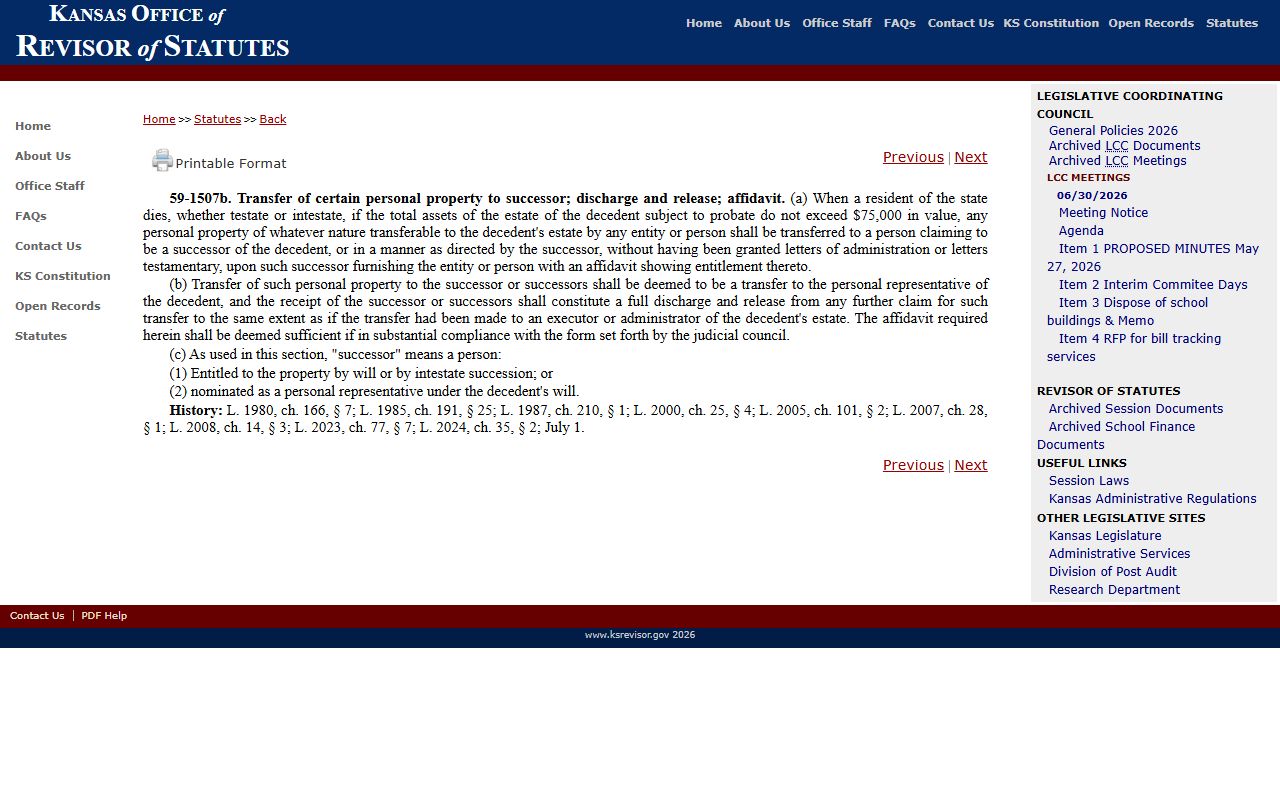
That statute source helps separate a qualifying small-estate affidavit from a formal estate case filed with the Probate Division of District Court.
Important: A small-estate affidavit may transfer qualifying personal property, but land-record consequences can still involve the Register of Deeds.
Sumner County Probate Process
The research gives a practical probate sequence for Sumner County. The first question is whether formal probate is needed at all. If not, the small-estate affidavit path may be reviewed under K.S.A. 59-1507b. If formal court action is needed, Kansas Judicial Council probate forms or attorney-drafted pleadings are filed with Sumner County District Court.
- Determine whether formal probate is required or whether a small-estate affidavit is enough for personal property.
- Use Kansas Judicial Council probate forms or attorney-drafted pleadings for the correct case type.
- File the petition or probate papers with Sumner County District Court.
- Track notice to heirs or creditors, inventory duties, bond issues, accounting requirements, and orders appointing a fiduciary.
- Search public case information in CaseSearch, then request older or not-online records from the clerk.
- Treat guardianship, conservatorship, and care-and-treatment details as potentially restricted.
Restricted Sumner County Probate Records
Not every probate-related record is open in full. Guardianships and conservatorships may include protected medical, financial, and personal identifiers. Care and treatment or mental-health proceedings may be restricted. Kansas public access rules also protect Social Security numbers, account numbers, medical treatment records, attorney-client material, and other closed or redacted information.
If the public portal shows only limited case information, that does not prove the full file is open or closed. Kansas Supreme Court Rule 22 controls electronic court-record access, and the clerk may need to separate open material from closed material before copies are released. For older files, public access may require the courthouse terminal or a written request rather than an online document view.
Probate files often combine public court action with private details. An order appointing a fiduciary may be open while a medical exhibit, protected person's financial account, or confidential identifier is withheld. A request should identify the specific order, pleading, or docket entry needed. Broad requests for every paper in a guardianship or care-and-treatment case may require review, redaction, or denial of closed parts under Kansas access rules.
Note: Adoption, sealed, expunged, juvenile, and protected-person material should not be treated as ordinary public probate content.
Sumner County Probate Fees
A Sumner-specific probate filing fee schedule was not located in official sources. The research does identify related Register of Deeds fees that may matter when a probate result must be recorded in the land records, such as a deed, certified instrument, or lien release. This distinction is important because the Register of Deeds is separate from the Clerk of the District Court.
When a probate order affects real property, the court order and the recorded land instrument may be two separate records. The court clerk can address the probate case file, while the Register of Deeds can address the recorded instrument, return-envelope rule, and recording fee.
| Item | Amount or Rule |
|---|---|
| Probate filing fee | Sumner-specific official amount not located in research |
| District court copy or search fee | Reasonable staff-time and expense fees may apply when requested through the clerk |
| County administrative KORA records | Actual costs may be charged and may be required in advance |
| Register of Deeds certification of instrument of record | $13.00 |
| Register of Deeds deed, mortgage, or other instrument first page | $21.00 |
| Register of Deeds additional pages | $17.00 each |
Probate case files belong to the court. Land instruments produced because of an estate may need recording with the Register of Deeds, whose office requires a self-addressed stamped envelope for returning recorded documents and uses P.O. Box 469 for most mailings.
That land-record step does not move the estate case out of District Court. A deed, release, or certified instrument recorded after probate is a Register of Deeds record. The petition, inventory, order appointing a fiduciary, accounting, and final settlement remain court records. Users tracing title after a death may need both offices, but they should ask each office for the record type it actually keeps.